Featured News

Pursuing Green Chemistry

Pharmaceutical Sciences

Improving Efficiency of Chemical Reactions 

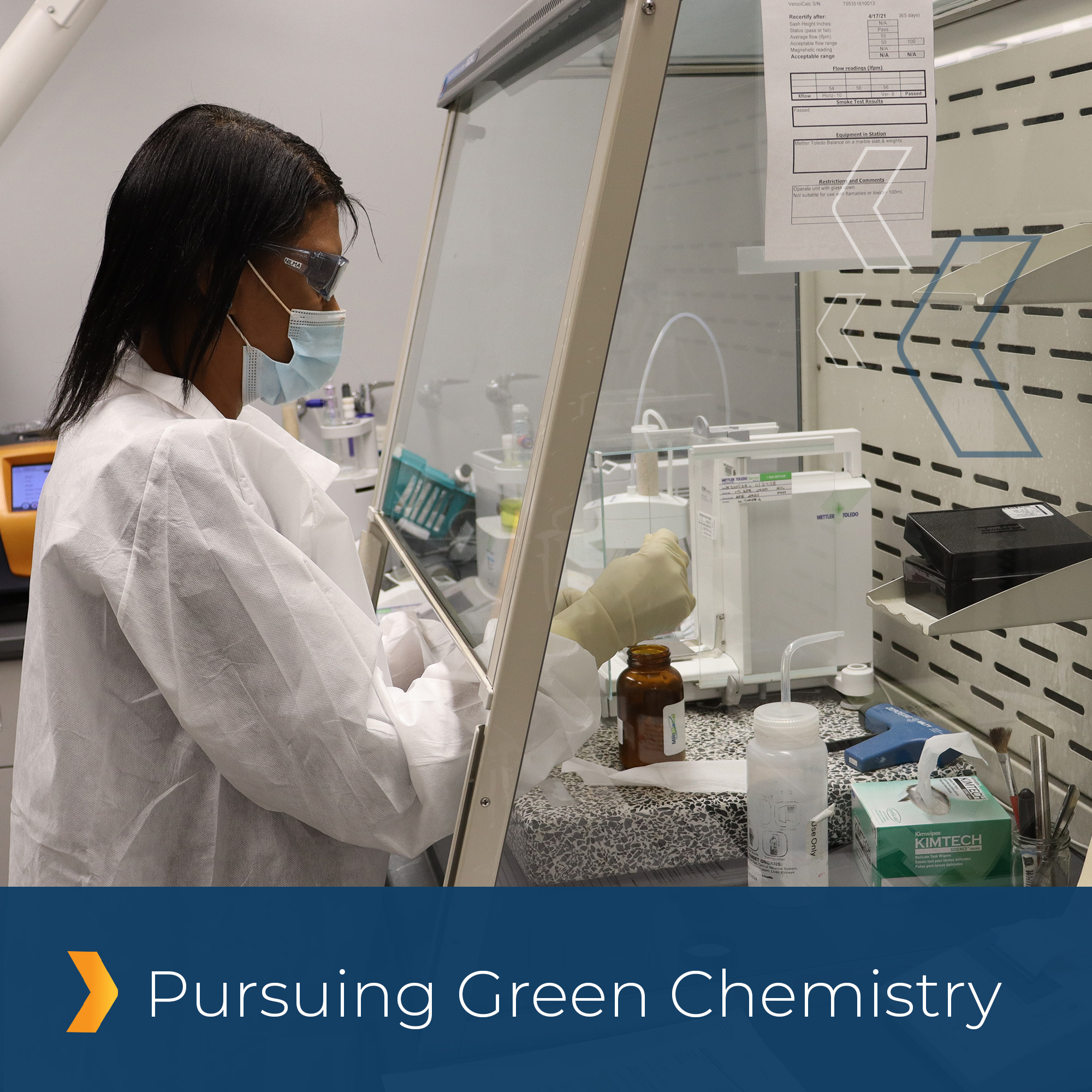
The chemical reactions used to produce pharmaceutical drug products also produce waste. This waste is sorted by similar materials and sent to a specialized facility for treatment or disposal, which can include methods like recycling, incineration, neutralization, or stabilization, depending on the type of waste and its chemical ability. At MRIGlobal, we’re committed to producing more efficient chemical reactions using a “green chemistry” approach. Doing so not only decreases the amount of waste and environmental impact resulting from these reactions, it also reduces researcher exposure to potentially harmful chemicals. Read more about MRIGlobal’s role in pharmaceuticals at “Generic Drug Development.” 

Per the Environmental Protection Agency (EPA), “green chemistry” is the design of chemical products and processes that reduce or eliminate the use or generation of hazardous substances. Green chemistry applies across the life cycle of a chemical product such as a generic drug, including its design, manufacture, use, and ultimate disposal. 


Interested in hearing more about how generic drugs are formulated to be effective, how they’re scaled from laboratory to manufacturing, and why they’re so important in improving access and affordability. Listen to the “Generic Drugs” episode of the Science Diction podcast from MRIGlobal!

Of the 12 principles of green chemistry noted below, one of several that our team is working to adopt is called “atom economy.” As noted in the second principle below, it refers to a measure of how efficiently a chemical reaction utilizes the atoms in its reactants, essentially calculating the percentage of reactant atoms that end up in the desired product. A higher percentage indicates a more environmentally friendly reaction and less waste generation. To improve the efficiency of chemical reactions, our team is very cognizant of the solvents and reagents we use. By designing reactions that more efficiently use those atoms and produce less waste, the process becomes more sustainable.  

The 12 principles of green chemistry are: 

  1. Prevent waste: Design chemical syntheses to prevent waste. Leave no waste to treat or clean up. 
  2. Maximize atom economy: Design syntheses so that the final product contains the maximum proportion of the starting materials. Waste few or no atoms. 
  3. Design less hazardous chemical syntheses: Design syntheses to use and generate substances with little or no toxicity to either humans or the environment. 
  4. Design safer chemicals and products: Design chemical products that are fully effective yet have little or no toxicity. 
  5. Use safer solvents and reaction conditions: Avoid using solvents, separation agents, or other auxiliary chemicals. If you must use these chemicals, use safer ones. 
  6. Increase energy efficiency: Run chemical reactions at room temperature and pressure whenever possible. 
  7. Use renewable feedstocks: Use starting materials (also known as feedstocks) that are renewable rather than depletable. The source of renewable feedstocks is often agricultural products or the wastes of other processes; depletable feedstocks are often fossil fuels (petroleum, natural gas, or coal) or mining operations. 
  8. Avoid chemical derivatives: Avoid using blocking or protecting groups or any temporary modifications if possible. Derivatives use additional reagents and generate waste. 
  9. Use catalysts, not stoichiometric reagents: Minimize waste by using catalytic reactions. Catalysts are effective in small amounts and can carry out a single reaction many times. They are preferable to stoichiometric reagents, which are used in excess and carry out a reaction only once. 
  10. Design chemicals and products to degrade after use: Design chemical products to break down to innocuous substances after use so that they do not accumulate in the environment. 
  11. Analyze in real time to prevent pollution: Include in-process, real-time monitoring and control during syntheses to minimize or eliminate the formation of byproducts. 
  12. Minimize the potential for accidents: Design chemicals and their physical forms (solid, liquid, or gas) to minimize the potential for chemical accidents including explosions, fires, and releases to the environment. 

Our commitment to improving chemical reactions through the application of green chemistry principles not only reduces waste, but also reduces researcher exposure to potentially harmful chemicals, and helps make these reactions more sustainable.  

GETTING STARTED AT MRIGLOBAL
Contact MRIGlobal for further information about our work in pharmaceutical sciences. Through a multidisciplinary approach, we provide customized pharmaceutical development solutions for government and commercial organizations. This includes expertise in pharmaceutical analysis, API manufacturing, clinical research support, repository management, and bioanalytical chemistry. 

SIGN UP FOR OUR NEWSLETTER
Sign up for the MRIGlobal newsletter! It’s the best way to get the latest updates in the world of applied scientific engineering research delivered directly to your inbox.